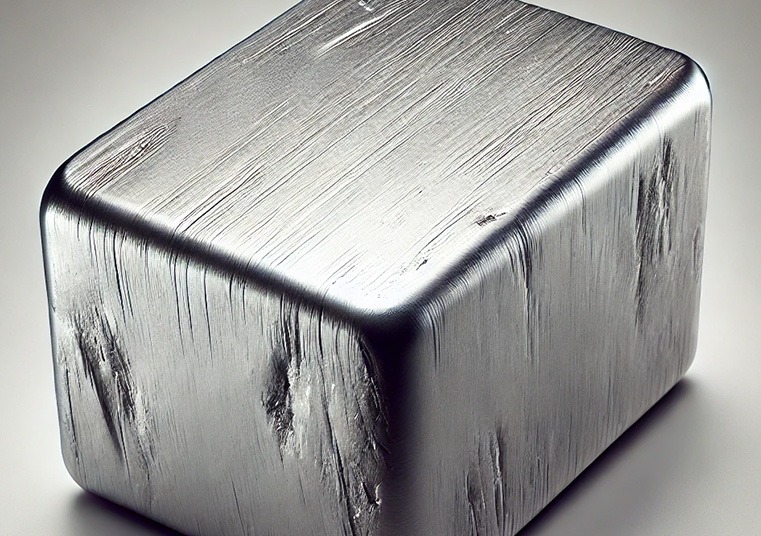
Germanium (Lat. Germanium) is a metalloid whose physical and chemical properties are very close to those of silicon. It is a brittle, non-toxic, greyish-white semiconductor (it conducts electricity better than insulators but worse than metals). The melting point of germanium is 938.25 °C and its boiling point is 2833 °C.
Because of its relatively high market price, germanium (chemical symbol Ge) is less commonly encountered in everyday life. Today most germanium is used in optics – in wide-angle and microscope lenses and in infrared (thermal imaging) lenses. Germanium is used in the manufacture of motion sensors, rectifiers, various light-emitting diodes and night-vision devices. Occasionally the element can also be found in jewellery making.
Germanium was once widely used in transistors and other semiconductor devices, but was later replaced by silicon; silicon-germanium (SiGe) alloys are increasingly used in high-frequency circuits. Germanium dioxide is used in the production of optical fibres, where germanium helps to control light transmission more precisely and reduce losses. Germanium-based solar cells, thanks to their very high efficiency, are used in spacecraft and other specialised applications.
Sources:
https://periodic-table.rsc.org/element/32/germanium
https://www.britannica.com/science/germanium
https://en.wikipedia.org/wiki/Germanium